Post from July 27, 2023
“👟 RSD 1185 ✅ via the last “3 Mile Thursday” of the summer (2 miles for me lol) with our cross-country team this morning. Today’s Verse: “Let us not become weary in doing good, for at the proper time we will reap a harvest if we do not give up.” — Galatians 6:9 (1+5=6:1+8=9)
The Message translation for Galatians 6:9-10 reads, “So let’s not allow ourselves to get fatigued doing good. At the right time we will harvest a good crop if we don’t give up, or quit. Right now, therefore, every time we get the chance, let us work for the benefit of all, starting with the people closest to us in the community of faith.”
Do you ever allow yourself to be proud? Not, like the bad kind (you know, vanity, narcissism—“Pride cometh before the fall”— Proverbs 16:18). I mean the kind of proud that’s victorious, triumphant. I mean the kind where you’ve worked very hard and are happy with what you’ve accomplished. It’s that intrinsic reward which, as long as you hold perspective, is healthy. Maybe you studied really hard for that test or put in the extra work to add distance to your run or weight to your lift. Maybe you met a goal that was years in the making. Maybe your child accomplished something, and you’re proud of them. The point is: it feels good when things we work hard for come to fruition. Depending on the goal, we work and work and work, but there’s always that glimmer in the distance of being “almost there,” so when we finally reach the goal, we’re happy in that we’ve achieved the goal and in that the promise of that goal has afforded us the tenacity to keep moving forward toward it. See, the goal isn’t just the goal; the goal represents development of strength of character; the goal represents time. It was the thing that kept us going when we wanted to scrub the mission and just do something else. And, sometimes, we just need a little encouragement to keep going. With a solid, reachable goal in sight and some encouragement, we’ve got this—whatever “this” is. So…what happens when the goal doesn’t seem so solid (like that science experiment you did in the 5th grade with water and baking soda making plasma), or the goal doesn’t seem so reachable (you know, they keep moving the goalpost), or there doesn’t seem to be much encouragement? Well, it seems that all we’re left with is the work part (the character development, yeah, but definitely the work). How do we overcome our fatigue then in pursuit of this moving goal? How do we know if we should even keep trying?
Today’s verse, the reflection on which I ironically had to tap out to fall asleep while writing, is about becoming weary (“feeling or showing tiredness, especially as a result of excessive exertion” — Google/Oxford) in the pursuit of doing good work. St. Paul recognizes here that being loving, trying to use one’s gifts, and genuinely trying to do what pleases God can have moments of fatigue and frustration. See, doing “the next right thing” isn’t always popular and is seldom easy, so people who are making a consistent effort in this might have moments of “What’s the point?” See, the tricky thing about doing good is that the goal is hard to describe (and sometimes hard to recognize or even understand), and the goalpost is always getting moved. If you work really hard or make a difficult decision trying to do right, you might have a moment where you feel like you’ve succeeded, but then you quickly realize that there’s more work to do. Whether it’s in that same situation or a new one that arises, there’s more work to do. The goalpost moved. So, you begin again. Repeat and repeat, and you begin to wonder if you’re really accomplishing anything. Accomplish, from Google/Oxford, means to “achieve or complete successfully.” Both the words “achieve” and “complete” have an element of ending. Once you’ve reached an objective, you’ve reached it. You did it! You feel that surge of pride and you rest for a minute, basking in your victory. Many goals we encounter are just like that, but I think this expectation might be why we keep feeling like the goalpost is moving away from our progress regarding goals that are little more plasma than they are solid.
Jesus tells us in John 13:15, “I have set you an example that you should do as I have done for you.” Pretty simple instructions, really. Practice hospitality; practice love; practice kindness; practice patience; practice serving. See, the thing that our brains aren’t really wired for (meaning societal norms) is that this isn’t a concrete thing like the rules of driving or Monopoly are; it’s situational. I know driving and Monopoly are too, but when dealing with human to human situations, it’s not exactly the same thing as passing “Go” and collecting $200. You do what God wants you to do in that moment, and sometimes passing “Go” requires a lot of you, and you are to collect nothing. Doing good work is often for gains outside of ourselves, and sometimes we don’t even get to see the goal come to fruition. It seems like we’ve done a lot, and, yet, nothing got done. In times like these, it can be really hard to keep going. What Paul is telling us here is that our mindset should be for the good of God’s kingdom and that, no matter how bleak it seems, all the things we do that are right and good are working together for something fantastic; so, all the “little efforts” we are making are not in vain. “Right now, therefore, every time we get the chance, let us work for the benefit of all.” The things will get done if we keep doing them. God will use them. See, Jesus gave us that charge, and here’s the thing: Jesus has never stopped working. The goal/achievement mindset is different because God’s Kingdom is infinite—ergo, there is no goal to reach and be “done”—there’s only a goal to keep reaching for. There is no “done” with God. It seems that, no matter how much we do, there is always more to be done because that’s exactly what’s happening. This can be overwhelming at times, so God does provide the encouragement part of the goal-reaching aspect that our brains like. “At the right time we will harvest a good crop if we don’t give up, or quit.” God periodically gives us guidance via His words and signs and situational “Ohhhhh” moments and through the people He sends to help us.
It’s like this (although St. Paul had a way better version of what I’m going to say). Pardon the personal anecdote, but it’s what I’ve got right now. In streak running, there are days and days where you feel as if you’re fighting through the workout (the challenges of being tired, being sore, maybe a small athletic injury…mostly being tired) instead of powering through the workout. You get into ruts. I certainly have them from time to time. Last summer going into Fall, I was fighting through the 800s, and every run was a chore. It had been a hard start to the school year, and I was just tired keeping up the streak. My kids (students—11th/12 grade) know I run (and how often) and were trying to get people to come to “3 Mile Thursday;” they bugged me about it for a couple of weeks. I didn’t think I could be a “run before school” person; sometimes I don’t get off of work until later in the evening. But, one week I went—RSD 870…and I was hooked. It was such a different atmosphere; running with the kids (and other dedicated adults) was such a vibe. Throughout the rest of the season, I saw kids who didn’t consider themselves runners come out for 3 Mile Thursday and really enjoy it—there were weeks where we’d be pushing 100 people on 3 Mile Thursday, and it was always a popular topic at school that day, “Hey, saw you at 3 Mile Thursday!” Plus, it showed me that I CAN be a “run in the morning” person 😱, and, since then, I’ve done many of my daily streak miles around 6 am. I changed things up, found some encouragement, and I found enjoyment in my runs again.
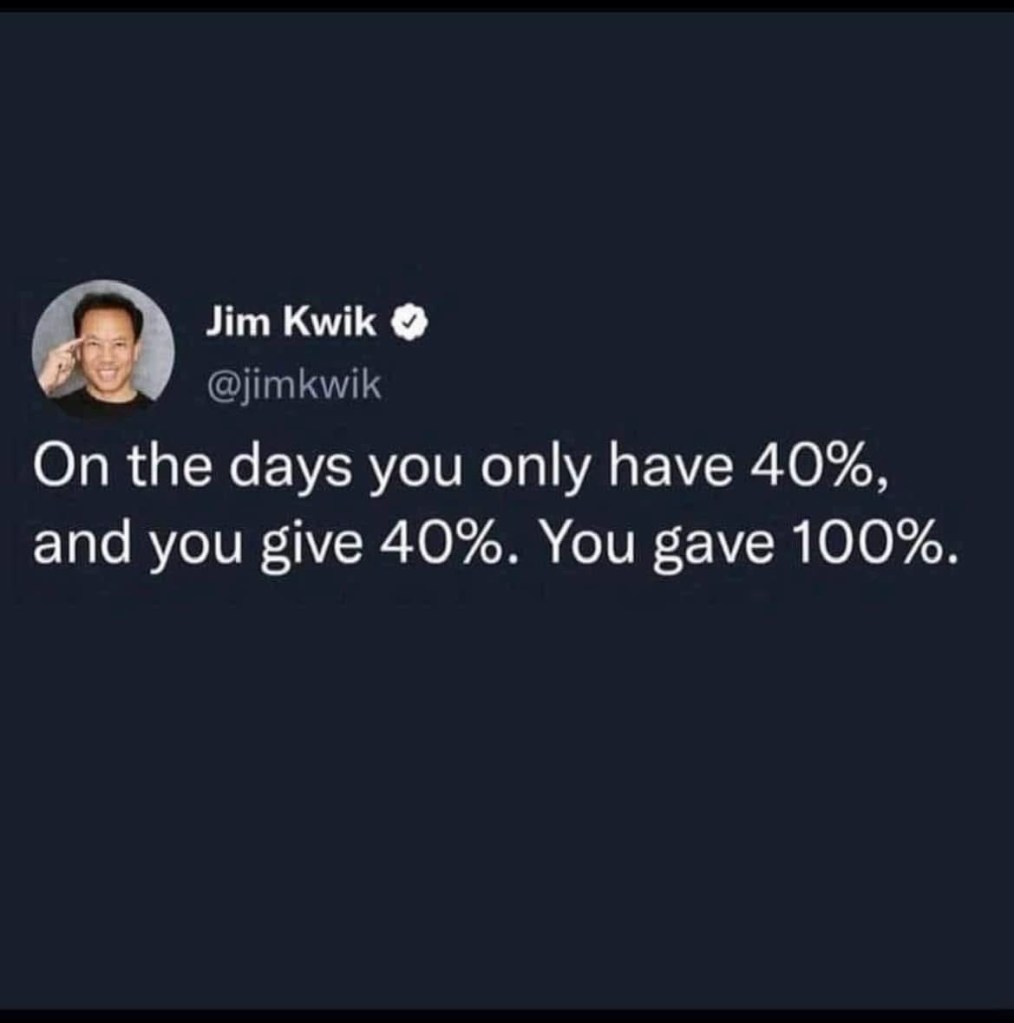
Sometimes we get tired of working toward things, especially when we can’t see an immediate (or even close) result. In those times, we might need a variety of things. We might need to change things up (like I do with my runs). We might need to change our perspective a little (as in, “I’m going to do the best I can, and hopefully it’ll be a good thing long-term”). We might need to rest, recharge, and come back strong. In today’s verse, Paul doesn’t mean we will never tire; he just advises that we don’t tire of our charge. The difference? Being tired is temporary: when we need to recharge, we need to recharge. God will help us get what we need to come back stronger. Tiring of our charge means that we lose interest in doing good work. “Why can’t somebody else just do it?” “It doesn’t seem to be doing anything anyway.” “I would rather do _____ than do what I’m called to do; I feel like my calling is hard.” These are human emotions because we can only see what’s in front of us, but God sees all. He sees the work we are doing and how it works together with the work others are doing (because it’s His work). As far as “why can’t somebody else ______,” God doesn’t actually need our help, and, if we drop the ball (more like throw the ball out of bounds), He can call someone else (or intervene with it Himself). But, the calling is ours. God made us perfect for our calling, and He knows that following what we are called to do will enable us to not only meet a need for others, but to develop into who we’re meant to be. There’s also the added bonus that us doing our best to do the Lord’s work will encourage others to do the same. Maybe that’s the real goal: yeah, it’s something that transcends a solid definition, but I think we get too caught up in things being defined with definite beginnings and ends—you know, solid parameters. The most precious things are achieved when we don’t worry about how we got into the situation or the end result but worry about doing our best work now. After all, God operates outside of “beginning and end” parameters, so it makes sense that His work does too. As far as goals being solid, remember that God can make anything solid, even if it doesn’t seem that way: Jesus walked on water.”
 Just One Mile
Leave a comment