Post from June 24, 2023
“👟 RSD 1152 ✅ Today’s Verse: “Then the Lord God formed a man from the dust of the ground and breathed into his nostrils the breath of life, and the man became a living being.” — Genesis 2:7 (1+1=2, 5+2=7)
So, I almost chose a different verse for today (I was between two verses). It as a good one (that, like this one, you’ve probably heard a lot (or at least heard of)). It’s about how we’re supposed to treat each other. I was in between that one and this one from Genesis. I decided to begin writing on one of them and see where it took me. I began writing on that verse and was reading some Bible commentary (a site called Crosswalk), when I came across this phrase at the beginning of the commentary describing the entire story of the Bible: “It pulls us up from the dirt in Genesis,” and I immediately knew that the Genesis verse was the right one for today. It’s a familiar verse, basically “God made the first human,” and it can seem mundane for the seasoned Bible reader or church goer. Not “mundane” in a bad way but in the fact that sometimes we become so “used to” the mighty works of God that they can become ordinary to us—you know, not surprising, and, if we’re not paying attention, not as wondrous. Y’all, God took dirt and made us. There isn’t anything ordinary about that. Ordinary (from Oxford Google), “commonplace” comes up most (and commonplace, from the same source, means “not unusual”). Not unusual? There isn’t anything ordinary about making an entire universe out of nothing—to even know there was going to be something when there was nothing…there’s nothing ordinary about that.
So, why aren’t our jaws on the floor every time we read Genesis? I mean, seriously. I’m wondering that too. Do you ever hear a word or write a word, and it always seems to remind you of something? Here’s one of mine. They remade Charlotte’s Web in 2006, and Sarah McLachlan wrote the sweetest song for the soundtrack that I remember from time to time, especially when I hear (see, write) the word “ordinary” (not every time, but you get the idea). Anyway, here are the introductory lyrics, “It’s not that unusual when everything is beautiful. It’s just another ordinary miracle today.” Later on in the song, she notes, “It seems so exceptional that things just work out afterall. It’s just another ordinary miracle today.” Ordinary miracle. You know what happens next. A miracle (Google/Oxford) is “a highly improbable or extraordinary event, development, or accomplishment that brings very welcome consequences.” So, an ordinary miracle is an ordinary extraordinary event. It seems contradictory—I mean, something’s either standard or it isn’t—and yet, ordinary miracle just makes sense. It isn’t that miraculous things just aren’t as miraculous: I think it’s that we don’t always think of things that happen every day as extraordinary. I mean, they happen every day, right? Wouldn’t that mean these happenings are commonplace? Here’s the kicker: they are.
Think of what happens every day, just scrolling through FB. You know, you get home from work, grab your phone, scroll through FB or the Gram, see what the world’s (your world’s) been up to, and what you find are the day’s ordinary miracles. Your friends are doing well, and you read post after post of information that makes you warm (not the temperature kind…the blanket over your chest on a cold night warm, the tests to your eyes warm). Somebody had a baby. Smile. Like. Scroll. Somebody’s engaged. Smile. Like. Scroll. Somebody’s celebrating a sobriety milestone. Smile. Like. Scroll. It’s somebody’s birthday. Smile. Like. Scroll. Somebody’s expecting. Smile. Like. Scroll. Somebody’s child hit their milestones in occupational therapy. Smile. Like. Scroll. Somebody who was very sick is healthily returning home to their family. Smile. Like. Scroll. Somebody fell in love for the first time and wants the world to know. Smile. Like. Scroll. Somebody got the new job they’ve been praying for. Smile. Like. Scroll. Somebody graduated college. Smile. Like. Scroll. Somebody’s child raised their reading level after months of hard work. Smile. Like. Scroll. Somebody got married. Smile. Like. Scroll. Somebody got baptized. Smile. Like. Scroll. Not bad for a Thursday, right? Here’s the thing, when you read these posts of good news and see these photos, you feel it in your heart, even for a moment. That smile? It’s genuine. That “like” is maybe the love or care reaction (or the like works too); maybe you’ll leave a comment of celebration, good wishes, or encouragement because you are happy that this has happened for them. Maybe you’ll even say a prayer of thanks on their behalf. We’re invested in each other when we celebrate these life events, and it seems that there are so many. After all, all you did was scroll through after work, so think of everything that happened today that didn’t make it onto FB. Somebody’s sunglasses fell when they took their foot off the brake, so they had to stay stopped for an extra second after the light turned green…and they looked up only to find another car racing through the light; a second does a lot more than you think. Somebody helped their friend leave a toxic relationship. Somebody gave a homeless guy the money he needed to eat that day and spoke kindly to him, making sure that he knows he isn’t invisible. Somebody overcame a fear.
The thing is, miracles ARE common, and I think that’s the point of many of the things found in Genesis (and elsewhere in the Bible too). We aren’t flabbergasted in disbelief when we read of wondrous things that God does because God has set up a place for us where miracles are an “all the time” thing. And, I don’t mean Heaven here (Heaven is even better): the place I’m referring to is Earth. We know that God is all-powerful (omnipotent, omniscient, omnipresent, omnibenevolent), and we know that it’s God who does miracles (both outright and through calling everyday people to loving actions). So, we find ourselves not always noticing the goodness and mighty works of God because He’s so good to us all of the time that we kind of get used to it. Taking a step back periodically from daily events to look at who’s making all of that happen (you know, being humble and grateful) enables us to realize that God does these “little ordinary miracles” all the time, and, here’s a really important part: noticing this will help us to lean on God when the miracles we need aren’t so “small,” aren’t so “ordinary,” and are WAY more obvious to us. What’s mind-blowing is that all of these miracles, the BIG ones and the small ones, are all the same to God. He has power over everything and cares for each of us so deeply, and giving ourselves time in our day to realize these miracles are manifestations of pure love will afford us the chance to wonder at the majesty of our Lord. See, we’re small compared to the universe, and there’s a lot we don’t know, so it’s comforting to remember that God is bigger than anything that comes our way and that He’s always with us. That part of today’s verse that tells us God “breathed into his nostrils the breath of life” means that all of us are breathed into life by God. He takes such care of each soul. Handcrafted. Uniquely designed. After all, only God knows what it took to make that “dust of the ground,” and He tells us over and over again how worth it we are.
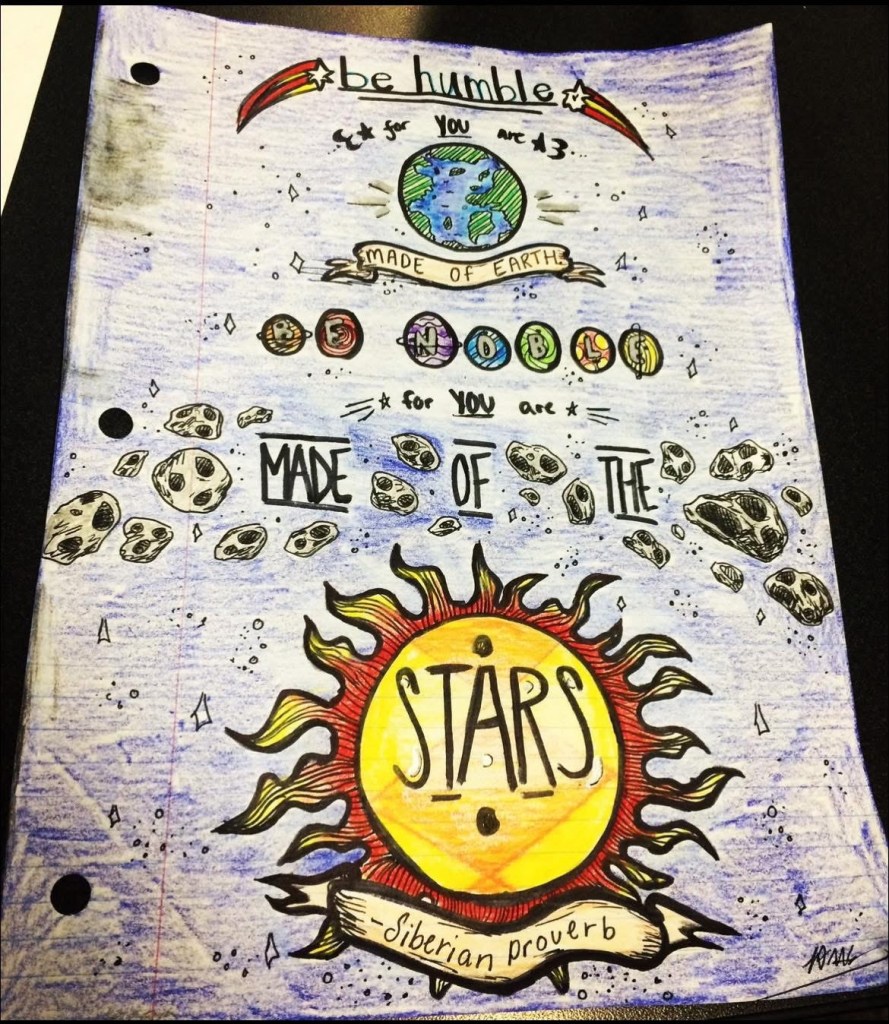
One of my favorite quotes is a Serbian proverb, and I kept thinking of it (thinking about “dust”). It juxtaposes life and being human with the elements of the universe in such a simple, yet deep, way. “Be humble, for you are made of earth. Be noble, for you are made of stars.” Here’s how we got the word noble (Google/Oxford): it’s “Middle English, from Old French, from Latin gnobilis [meaning] ‘noted, high-born’, from an Indo-European root shared by know.” We come from dirt: on Ash Wednesday, one of the sayings is, “Remember you are dust, and to dust you shall return.” So remembering that is a good reality check for us; that’s the “humble” part. But, it’s also the same dust that shares the same elements found in the planets, comets, and stars, and God thinks of us all the time, so that’s the “noble” part. The fact that noble shares a root with the word know was an added bonus for me. God knows us.
Today’s photo is from a student years ago. I have it laminated on my classroom door.”
 Just One Mile
Leave a comment