Post from August 1, 2023
”👟 RSD 1190 ✅ Today’s Verse: “I have seen something else under the sun: The race is not to the swift or the battle to the strong, nor does food come to the wise or wealth to the brilliant or favor to the learned; but time and chance happen to them all.” — Ecclesiastes 9:11
The Message translation: “I took another walk around the neighborhood and realized that on this earth as it is— The race is not always to the swift, Nor the battle to the strong, Nor satisfaction to the wise, Nor riches to the smart, Nor grace to the learned. Sooner or later bad luck hits us all.”
Do you ever notice that some things seem to happen by chance? Whether or not you think that all of the time, you’d have to admit that it crosses your mind from time to time. We all know that almost nothing in this life is guaranteed (enter the joke about death and taxes…eye roll), and we’d probably all agree that luck or chance happens in both the good fortune and bad fortune categories. According to Google/Oxford, chance can simply mean, “a possibility of something happening,” in which case literally everything is chance, or it can mean, “the occurrence and development of events in the absence of any obvious design,” in which case it’s more a matter of opinion and perspective. Regardless of your definition, we know that things happen in our lives that make no sense, and things happen that almost make too much sense. Here’s that second point via a personal anecdote from today. I was checking out at a store, and the two girls at the checkout counter were talking GPAs. They were comparing notes and had a couple of different ideas about how many A’s, B’s, etc needed for one girl to be in good standing with her scholarship (she starts this fall and wants to be ready). Well, my teacher instinct took over, and I gave them a crash math/GPA lesson on how classes with 4 hours (credits) are “more GPA points” than classes with 2 hours (credits) and how to calculate it, explaining how it’s a little different from high school. We talked for a minute, and I answered their questions; they seemed to feel better about that aspect of starting college. So, sports fans: what are the odds that they’d be having that conversation at the exact moment I came up? I don’t even frequent this store. This is one of those “by chance” things. Or, did it happen the way it needed to so that the girls were able to get the information they needed? Regardless of why, the result is the same.
So, why does the “before” part matter to us so much? My guess: control. See, so many things seem to happen that we can’t predict or reason with, so, when we can exact some linearity to it, we hold onto that sense of control. It makes us feel better to think we can at least predict things. Or, for people who think everything is random, the comfort is into the fact that, since everything is random, they don’t have to worry about trying to guess. Chance is funny: we like it and don’t like it at the same time. I think it makes us nervous because we forget the truth sometimes…not like forget forget, more like forget to remember, but the truth is that God is always in control. He will intervene or not, depending on His will (which is more perfect and complex than we could ever imagine, so a lot of times we “don’t get it”). Sometimes things seem random that aren’t because we can’t see the workings, and sometimes things, well, just are. We’re not meant to make sense of everything, although we try. Let’s consider the remedies for difficulties in decision making (hey, you can’t always decide on a restaurant, am I right?): flip a coin, rock/paper/scissors(lizard/Spock for my fellow “Big Bang Theory” fans), choosing straws, tossing dice…casting lots (that ancient game of chance).
Ever look at someone doing something (like a job or something) and think of how perfect that path is for them (and for those around them because they’re so good at it)? Like, it almost seems as they were meant for it? E.g. your loved one found the perfect doctor to treat their condition, or your child has had trouble in school and somehow gets the perfect teacher for their needs, or some college student has no idea what to do after college and somehow gets the exact professor who leads them to a career they love and make an impact through, or the fact that Michael Phelps’s mother at some point would’ve had to look at her little boy and think to herself, “I wonder if Michael might like swimming lessons”—imagined her thinking of that while watching him win the Olympics. Do you ever wonder how that person who seems meant to do the thing got there or what transpired to put that person in that place at that time? As ahem “chance” would have it: the Bible has some great examples. In beginning of the Book of Acts, the (eleven) disciples are trying to set things up to spread the message of hope and salvation through Jesus Christ. Peter thinks of something in Proverbs and (with the others) arrives at the conclusion that they needed to select a twelfth disciple among the people who had been following their ministry (“Therefore it is necessary to choose one of the men who have been with us the whole time the Lord Jesus was living among us beginning from John’s baptism to the time when Jesus was taken up from us. For one of these must become a witness with us of his resurrection” — Acts 1:21-22). See, Jesus had chosen twelve, and they felt this was important…and, after Judas Iscariot had betrayed our Lord, his position…became vacant, so they worked together to find the perfect replacement—big calling, big responsibility. “So they nominated two men: Joseph called Barsabbas (also known as Justus) and Matthias. Then they prayed, ‘Lord, you know everyone’s heart. Show us which of these two you have chosen to take over this apostolic ministry, which Judas left to go where he belongs.’ Then they cast lots, and the lot fell to Matthias; so he was added to the eleven apostles” — Acts 1:23-26. That’s how we got St. Matthias. The important thing to note here is this: they prayed for the right person to be chosen; they prayed for God to show them who it was to be, and then they casted lots. A game of chance, like flipping a coin—yet, the person who was meant for the task “somehow won.”
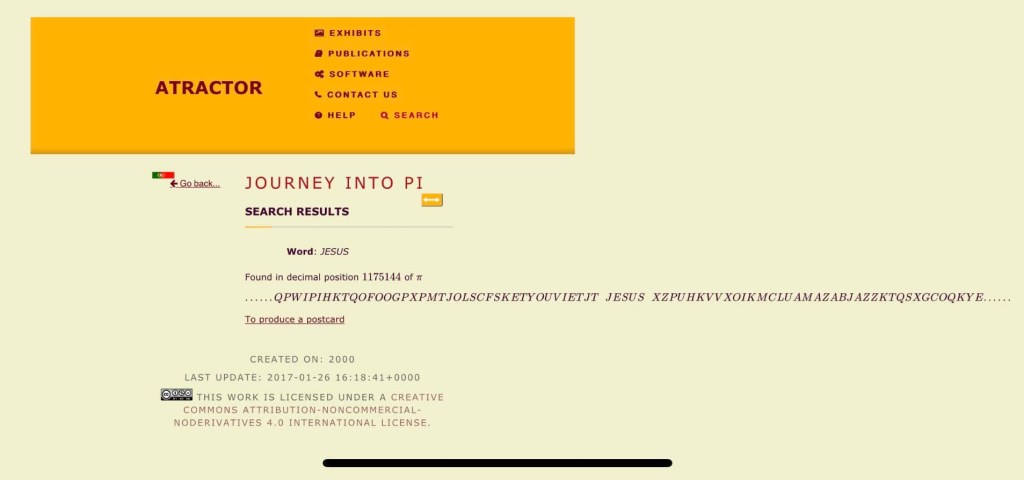
The idea of chance opens the possibility that things can happen at random (“made, done, happening, or chosen without method or conscious decision” — Google/Oxford). Like, when they generate random numbers to determine the winner of a contest or to determine a random sequence of numbers to generate a barcode. In college, I took a course in C++ (a computer coding language), and we had to write programs to generate random variables. In that class (plus it came up again in grad school), I learned that some more complicated algorithms (kind of like formulas) use the digits of pi to help generate a random collection of things. We all love pi: apple, pecan, pumpkin, chocolate meringue—but the pi I enjoy most has a different flavor. It begins with 3.14, and it a non-terminating, non-repeating decimal (infinite, no pattern). BUT. Since pi is never-ending and unpredictable, there are theories that every person’s name can be found in the digits of pi (if you assign the digits to letters…think like 0=A, 1=B, 25=Z…there are multiple ways to do this (some better than others), but you get the idea). Makes sense, right? A whole bunch of numbers means that, when you assign the numbers to letters, you get a whole bunch of letters…so your name is totally in there somewhere. What if somebody’s name is also a word (e.g. grace, love)? Those are in there.
Here’s the kicker: if you have infinitely many combinations of numbers, assign them to letters, have infinitely many of those, then you have every sentence you could think of hidden somewhere in the expanse of pi. Your name alongside your spouse’s name. Your child’s first, middle, and last name. Your college degree, with the major, and the year (spelled out). Your birthdate. Your death date. The day you lost your first tooth. The day you took the training wheels off your bike. The day you were baptized (with your name—all in word and sentence form). Anything we have done and will ever do is in there somewhere. All the possibilities, all the chances. Everything that did and did not happen—the car wreck you missed, that pothole you didn’t turn your ankle in because you saw it last-minute. Everything that could or could not happen—“We found the cure for _____ in the year _____,” or “George Washington, was re-elected for third term in the year 2024.” Could or could not happen—you know, physics, biology, chemistry, laws of nature, choices, free will, laws of virtue—all possibilities. Isn’t it funny that this is what’s used to generate a lot of random numbers? Yet, everything’s in there, waiting to be discovered. Pi currently has 62.8 trillion known digits, but there are so many more than that, more than we can imagine…almost as if the One who set up mathematics in the first place wanted to remind us that all of these things that we see and experience are all, ultimately, under control. They’re in His hands.
So, today’s verse: what’s the deal with the chances if God is in control? Well, “this Earth, as it is” isn’t perfect. John 16:33 tells us Jesus’s words, “‘I have told you these things, so that in Me you may have [perfect] peace. In the world you have tribulation and distress and suffering, but be courageous [be confident, be undaunted, be filled with joy]; I have overcome the world.” [My conquest is accomplished, My victory abiding.]’” (Amplified Bible translation). There are things (think like free will, presence of evil) that throw aspects of life off-balance—not everything is a direct consequence of these, but these things make the world imperfect, so accidents, random unfortunate circumstances do happen. Sometimes God fixes this for us, and sometimes He uses times like these to help us develop in our character, and, even when bad events don’t alone work for good, God will always continue to work for our good, no matter what events occur. The author of Ecclesiastes, Solomon, brings up good points in today’s verse: that sometimes, even when you’re doing your best, things don’t work out. Basically, life isn’t fair: hard work doesn’t always bring a reward, and bad actions don’t always produce a negative consequence. Free will—it’s a trip. Think about it: Michael Jordan didn’t make the varsity basketball team his first time to try out, and Bernie Madoff lived in luxury for years. But, continually working hard or continually being a corrupted individual will eventually bring their own reward (good or bad)—Michael Jordan eventually made the Hall of Fame, and Bernie Madoff eventually died in prison. We have no way of knowing what events will transpire, amidst the random twists and turns of life, but we can’t let not knowing the outcome affect our quest to do good work. God is in control of every ultimate outcome. So, even if we don’t see it in front of us, all of that work we’re doing for good will eventually be used as a part of something great.
“The race is not always to the swift”: maybe you ran the fastest in the race but tripped over something near the end; you’ll keep working hard, try again, and eventually have another chance for a victory. “Nor the battle to the strong”: the Greeks (mainly Spartans) lost the Battle of Thermopylae Pass (last stand of the 300), but Greece ultimately prevailed against Persia. “Nor riches to the smart”: Nikola Tesla gave up his patent for AC electricity (so that they could win Niagara Falls contract and make AC electricity the standard), and he died poor; yet, his contribution to science is the reason you didn’t electrocute yourself when your flipped on the light switch or plugged in your phone. Some things are more important than money. We don’t need to worry about the outcome; we might not even see the ultimate good our actions help to accomplish, but there is good that they will help to accomplish. Grains of sand on the beaches of humanity. So, maybe some things do happen by chance, and there’s nothing we can do about that fact. But, we can take comfort in the fact that all the possibilities for our lives contained in infinite, non-repeating patterns rest in the hands of the only One who knows all the digits of pi and has the perfect plan for our future.
Today’s photo is from the “Journey Into Pi” project (they use just over 2 billion digits (just over three tenths of one percent of the known digits)…so if you try it, you might have to use a shortened version of your name). I typed in “Jesus.””
 Just One Mile
Leave a comment