Post from June 29, 2023
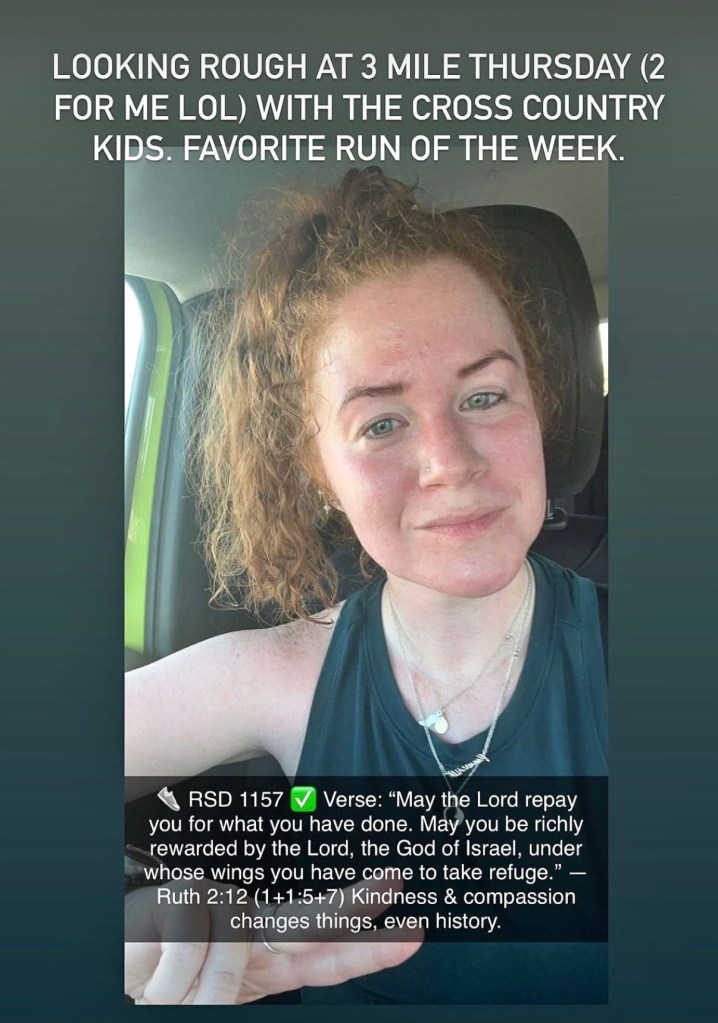
“👟 RSD 1157 ✅ Today’s Verse: “May the Lord repay you for what you have done. May you be richly rewarded by the Lord, the God of Israel, under whose wings you have come to take refuge.” — Ruth 2:12 (1+1=2:5+7=12)
Language varies, and language evolves. It seems that the more we want to describe (especially indescribable) things, the more creative ways we push phrases into our lexicon. You know, the “come in clutch” I’ve been using in some posts. So if you’re “up on the latest lingo,” meaning you remember lingo that’s been popular for years (and you know that “up on the latest lingo” is, ironically, embarrassingly outdated), you’ve heard (and probably used) the colloquial phrase “ride or die.” Now, a quick search on Google will find you a few different definitions, but most of them say pretty much the same thing (including Urban Dictionary, which, let’s face it: is the authority on colloquialisms): a “ride or die” pertains to the quality of loyalty in a friendship. You’re like, “Why not just say ‘best friend’?” Well, the name says it all. Your “ride or die” friend is loyal to you until the end, the type of friend who isn’t going to leave early from the party you’re throwing; they’ll come early, help you take care of your guests (especially if you’re nervous), and stay to help you clean up (and will probably hype you up thereafter about what a great time everyone had, how perfectly in balance the food/drink/entertainment was, and, of course, how awesome you looked). Your “ride or die” friend is there for you. They’ll make you believe that you can do anything in the best of times and make you believe you’ll make it through the worst of times; it’s an added bonus of this type of friend that they’ll be walking (or, you know, riding) alongside you through it all. When you have a friend like this or notice this quality in a person you know with another person you know, it’s quite heartwarming. That sort of loyalty is a pure expression of love and the value these people hold for each other. It’s sweet to see when people stick by each other and stick up for each other in a world where it’s easy to only look after yourself. It’s one of the qualities of a solid human, and people love solid people. They give us hope that maybe we can make this whole “on Earth as it is in Heaven” (Matthew 6:10) happen afterall.
Today’s verse is a man named Boaz talking to a woman named Ruth. Basically, he had a front-row seat to Ruth being a solid human and wanted the best things to come her way in return. When people in Ruth’s day said “May God grant _____,” they truly meant it, even in prayer (many faithful people today do as well). But, this was a special sort of acknowledgment of Ruth being awesome because Ruth wasn’t from Israel (remember the class system we discussed the other day with the Samaritan woman? People didn’t always take notice of people who were of a different background); Ruth was from a place that practiced a pagan religion, meaning she not only wasn’t from there or shared in their background—she was from a place that didn’t acknowledge God. The Book of Ruth isn’t super long (I read it today); it’s a story with a simple thread throughout and not really any subplots. It begins when Ruth marries an Israelite and proves to be an incredibly loving person, both to her husband and to his extended family. Tragedy strikes when her husband, brother-in-law, and father-in-law die, forcing them to move back to where her mother-in-law is from. Her mother-in-law, Naomi, tells Ruth to go back to where she’s from to try and marry again (women didn’t have many options in those days); this was selfless of Naomi because it would leave her all alone to fend for herself (again, not great employment opportunities), but she wanted Ruth, who she loved and who loved her, to be happy and have a full life. This is where the “ride or die” part comes in. Ruth tells Naomi “no” a few times, finally putting it in a sweet, yet straightforward way. “But Ruth replied, ‘Don’t urge me to leave you or to turn back from you. Where you go I will go, and where you stay I will stay. Your people will be my people and your God my God. Where you die I will die, and there I will be buried. May the Lord deal with me, be it ever so severely, if even death separates you and me’” (Ruth 1:16-17). Ride or die. Ruth knew that Naomi had already lost a lot (2 sons and a husband) and didn’t want her to lose a daughter too (technically daughter-in-law, but Ruth’s love transcended legal technicalities). Ruth knew that going back to her hometown to marry some guy would almost guarantee her safety and security for the rest of her life, but she’d have to leave Naomi all on her own. Ruth was loving, compassionate, and believed in sticking together, even if that was the harder road. Ride or die. And, through her husband and Naomi, Ruth had learned of God and had the faith to trust Him. Ruth was one of those “do the next right thing” people (yes, that’s from Frozen 2), and she made her decisions out of faith and love. She wasn’t sure what she and Naomi would do, but she somehow knew they’d find a way. Ride or die.
Ruth also proved to be hard-working and resourceful and immediately found a way to gather cast-away crops (i.e. crops that wouldn’t sell—this was a common practice back then) to provide for her and Naomi. Boaz owned the land where Ruth was gathering the cast-off grain, and his workers told him her story of why she moved to town and of how hard she worked in the fields. Boaz meets Ruth, and that is where he told her that he had “been told all about what [she has] done for [her] mother-in-law since the death of [her] husband—how [she] left [her] father and mother and [her] homeland and came to live with a people [she] did not know before” (Ruth 2:11). Ruth’s actions were kind and loyal and brave…and all-around loving. That kind of selflessness makes a person stand out, you know? A true “ride or die” girl. A good and loving person who doesn’t give up. Someone with integrity and grit. The story has a happy ending. After working for Boaz for awhile, they marry, and Ruth has a son. Ruth continues to treat Naomi like her own mother, dear friend, loved one, and, as friends of Naomi’s pointed out to her in congratulating her on her grandson’s birth, “your daughter-in-law, who loves you and who is better to you than seven sons, has given him birth” (Ruth 4:15). The “better than seven sons” part—BIG compliment back in the day. The whole community knew the story of Ruth and Naomi’s kinship, the kind that shows people what love looks like. A bonus for Ruth and her legacy: her great-grandson ended up being someone super important. Remember King David? The Book of Ruth is the story of how his great-grandparents met. That town Ruth and Naomi moved to? You’ve probably heard of it: Bethlehem (Luke calls it “The City of David”)…because THE Mary and Joseph had to go there for the census (and Jesus ended up being born there) because…wait for it…they were related to David. Ruth is actually mentioned in Matthew regarding the genealogy of Jesus Christ. Yeah, that’s right: Jesus’s great (x like 20-something) grandmother. How’s that for a legacy—how’s that for “richly rewarded by the Lord”? Hey, she has a book of the Bible named after her, and Ancestry (dot com) couldn’t come close to a family tree like this.
Boaz’s prayer and wish for his future wife began a chain of events that would change history. Ruth’s choice was to follow her heart and to keep faith and hope (seeking shelter “under [the] wings” where she’d find the protection of God). Come to think of it, her great-grandson sought refuge under those same wings (“He will cover you with His feathers, and under His wings you will find refuge; His faithfulness will be your shield and rampart” — Psalm 91:4). While trusting in God’s help, Ruth decided to be brave in that she was probably scared but did the right thing anyway—her making the choice to let love make her brave day after day (when she could’ve bailed) began a chain of events that would change history. The literal entire world’s history…and our future as well. That’s right: OUR future. And, here she thought she was just doing what you do when you love somebody. Imagine that. Simple acts of love often aren’t simple in task or in the courage they might find necessary: they’re simple in that they only require the answer to the question, “How can I love?”
(Edit 2026: the original photo was me with the coaches and the kids, so I used this one instead) Today’s photo is “3 Mile Thursday” today at school: my favorite run of the week.”
 Just One Mile
Leave a comment